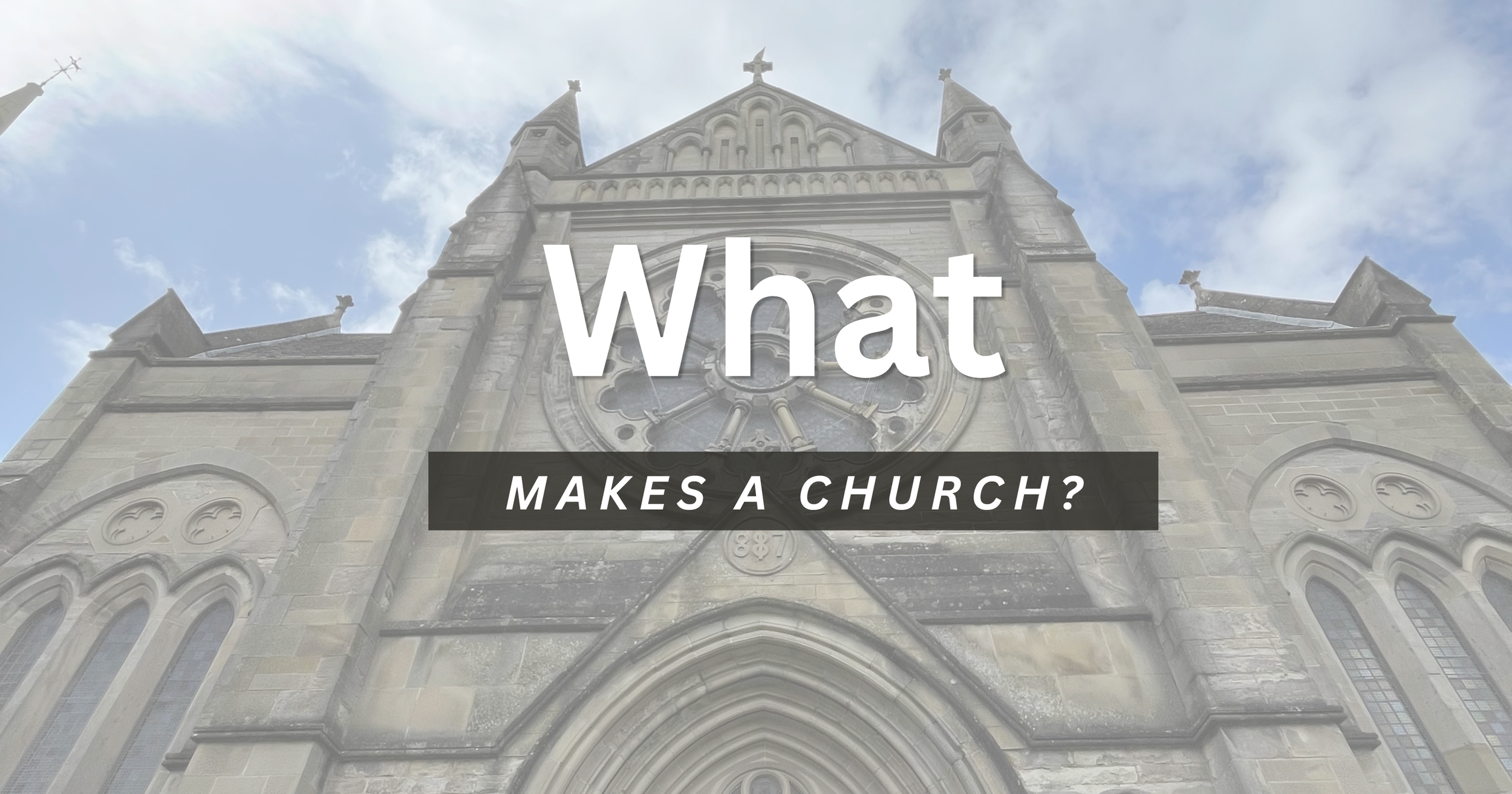
It can be difficult to define a church. Hear the word ‘church,’ and you probably picture a building. But if you’ve been involved in a church for any length of time, you’ve probably heard someone say, ‘the church is more than a building,’ and you might even have nodded along sagely.
So is a church a building? Is it something more amorphous? Does it even matter?
Theology of the church, in one verse
In 1 Corinthians 1:2, Paul delivers a beautiful, wide-ranging definition of a church. Here’s the verse:
“To the church of God at Corinth, to those sanctified in Christ Jesus, called as saints, with all those in every place who call on the name of Jesus Christ our Lord—both their Lord and ours.
”
Each of those phrases conveys a small facet of what a ‘church’ actually is. We’re going to cover each one in a series of blog posts, one on each of the phrases. Along the way, we’ll build a definition of a Christian church, one that applied to the church at Corinth, to the church at Dumbarton Free, and to any church that truly worships Christ Jesus ‘in spirit and in truth.’
What makes a church? A church is a:
True church
Local church
Christian church
Holy church
Universal church
Worship church
Unified church
I hope that this series will be short, sweet, and give you a quick glance at something called ecclesiology — the theology of the church itself. And along the way, I hope that it will show you just how important this thing called ‘church’ actually is.
The Christian Church is the True Church
Let’s start where Paul does. He addresses ‘the church,’ and then immediately identifies the most important feature: it is ‘of God.’ Right away, we’re left in no doubt. Regardless of why Paul is addressing this group of believers, they are God’s people.
We could say, ‘the Christian church is the divine church,’ if we want to capture that idea more directly. But I think ‘true church’ sums it up even better, because God is truth. Jesus comes and declares that He is ‘the way, the truth, and the life,’ and the church that gathers in His name is the true church. It is true, because it is of God.
The church as a new identity
It’s worth clarifying something here, and it has to do with the word ‘church’ itself. In Greek — the language Paul originally wrote in — the work ekklesia, translated ‘church,’ simply refers to a gathering of people. But while I say ‘simply,’ that not entirely true — clearly, Paul isn’t just referring to ‘that gorup of people who happens to be in a single spot on a Sunday.’
And actually, the word itself indicates as much. Ekklesia was the word used in the Septuagint, the Greek translation of the Hebrew scriptures used by Jesus and the Apostles, for the people of God when they gathered together. There’s a great example in the book of 1 Chronicles, near the end of David’s reign:
And David the king said to all the assembly, “Solomon my son, whom alone God has chosen, is young and inexperienced, and the work is great, for the palace will not be for man but for the LORD God. 2 So I have provided for the house of my God, so far as I was able, the gold for the things of gold, the silver for the things of silver, and the bronze for the things of bronze, the iron for the things of iron, and wood for the things of wood, besides great quantities of onyx and stones for setting, antimony, colored stones, all sorts of precious stones and marble. 3 Moreover, in addition to all that I have provided for the holy house, I have a treasure of my own of gold and silver, and because of my devotion to the house of my God I give it to the house of my God: 4 3,000 talents of gold, of the gold of Ophir, and 7,000 talents of refined silver, for overlaying the walls of the house, 5 and for all the work to be done by craftsmen, gold for the things of gold and silver for the things of silver. Who then will offer willingly, consecrating himself today to the LORD?”
6 Then the leaders of fathers’ houses made their freewill offerings, as did also the leaders of the tribes, the commanders of thousands and of hundreds, and the officers over the king’s work. 7 They gave for the service of the house of God 5,000 talents and 10,000 darics of gold, 10,000 talents of silver, 18,000 talents of bronze and 100,000 talents of iron. 8 And whoever had precious stones gave them to the treasury of the house of the LORD, in the care of Jehiel the Gershonite. 9 Then the people rejoiced because they had given willingly, for with a whole heart they had offered freely to the LORD. David the king also rejoiced greatly.
The Holy Bible: English Standard Version (Wheaton, IL: Crossway Bibles, 2025), 1 Ch 29:1–9.
See the word ‘assembly’ there? That’s our word ‘church.’ Here, they’re gathered as the people of God, to witness what God has done, hear the words of David, and offer their own riches to God. As the passage goes on, they’ll pray and bless the Lord, worshipping him.
With that in mind, you can see why Paul’s identification of this group of Jesus-followers as ‘the church of God’ puts them squarely in the same vein as the Old Testmanent Israelites. This is immensely significant; the Corinthians are Gentiles, not Jews, and Paul still identifies them as ‘of God,’ the true church.
The church as redemptive story
There’s one more thing happening here. By starting with ‘of God,’ Paul puts the focus on the long-running plan of redemption God the Father has been working.
Let’s be clear, here: the church — be it in Corith or Dumbarton — is there because of God’s plan of salvation, worked out throughout his Word, and brought to full bloom in the life, death, resurrection and ascension of Jesus Christ. Paul says as much in another letter to a different group of believers, the Ephesians:
3 Blessed is the God and Father of our Lord Jesus Christ, who has blessed us with every spiritual blessing in the heavens in Christ. 4 For he chose us in him, before the foundation of the world, to be holy and blameless in love before him., 5 He predestined us to be adopted as sons through Jesus Christ for himself, according to the good pleasure of his will, 6 to the praise of his glorious grace that he lavished on us in the Beloved One.
7 In him we have redemption through his blood, the forgiveness of our trespasses, according to the riches of his grace 8 that he richly poured out on us with all wisdom and understanding. 9 He made known to us the mystery of his will, according to his good pleasure that he purposed in Christ 10 as a plan for the right time—to bring everything together in Christ, both things in heaven and things on earth in him.
11 In him we have also received an inheritance, because we were predestined according to the plan of the one who works out everything in agreement with the purpose of his will, 12 so that we who had already put our hope in Christ might bring praise to his glory.
13 In him you also were sealed with the promised Holy Spirit when you heard the word of truth, the gospel of your salvation, and when you believed. 14 The Holy Spirit is the down payment of our inheritance, until the redemption of the possession, to the praise of his glory.
Christian Standard Bible (Nashville, TN: Holman Bible Publishers, 2020), Eph 1:3–14.
It’s an incredibly rich passage, but the clue is in where Paul starts; with the plan of God the Father. And lest we think that this is some peculiar view of Paul’s, here’s the apostle Peter:
“3 Blessed be the God and Father of our Lord Jesus Christ! According to his great mercy, he has caused us to be born again to a living hope through the resurrection of Jesus Christ from the dead,”
There’s far more there in 1 Peter 1, so please go read it for yourself. The point is this: the church ‘of God’ is a new identity that comes from God’s plan of redemption. If you’re wanted to define what a ‘church’ is today, that’s the first part: it is the true church, because it comes from God the Father and identifies His people.
This also helps to define the church as truly Christian. There aren’t any Muslim churches, because that word, properly used, refers to the people of God as He has revealed through His Word and the work of His Son Jesus Christ.
The True Church Opposed
“If the church is to be the true church, because it is ‘of God,’ then it cannot deny Him. Any church that denies the existence of God, or His plan of redemption, or His power to bring that plan about, is no true church.”
Let’s consider some of the ramifications here. If the church is to be the true church, because it is ‘of God,’ then it cannot deny Him. Any church that denies the existence of God, or His plan of redemption, or His power to bring that plan about, is no true church.
We’ll get into more specifics later, but like the example of Islam above, there’s a helpful clarity here. Let’s take another dramatic example; already, by definition from 1 Corinthians 1:2, we can see that there is no such thing as a ‘Satanist church.’ That group flatly denies, and indeed opposes, the most fundamental aspect of a church. It may use the word, but that’s it — the definition doesn’t apply.
We’ll get to other, less-clear examples later. But for now, hopefully we’ve seen that the Christian church is the true church, the ‘church of God.’
I’ll leave you with a challenge: are you truly part of the church? Not, ‘do you attend a church building,’ because that’s only partly relevant to the actual question. Are you a part of the church of God? Have you grappled with your need of a Saviour from your sin, the love of God, the death of Christ on the cross, and the new life we can have in him?
If you haven’t, no membership to any particular building will make you part of ‘the church.’ And if you have, well then. The opposite is true — you are the church, because you have been born again of God.